Wildlife of the eastern forests
Forest elephants, gorillas, bongos, grey parrots… Discover the species documented in the parks and reserves of the region, and where to see them.
Wildlife of the eastern forests
 CR
African forest elephant
Loxodonta cyclotisThe giant of the Congo Basin forests, smaller and more discreet than the savanna elephant. The south-eastern parks hold some of its highest densities in Africa.
 CR
Western lowland gorilla
Gorilla gorilla gorillaThe largest primate. Lobéké has some of its highest densities in Africa, and Deng Deng holds its northernmost known population.
 EN
Chimpanzee
Pan troglodytesOur closest relative, highly intelligent and social, found in several parks of the region.
 NT
Bongo
Tragelaphus eurycerusThe largest forest antelope, with a chestnut coat striped in white. Elusive, it is one of the prized sightings in the clearings of the East.
 LC
Sitatunga
Tragelaphus spekiiThe swamp antelope: its long, splayed hooves let it walk on mud and floating vegetation.
 NT
African forest buffalo
Syncerus caffer nanusSmaller and redder than the savanna buffalo, it forms herds that can be seen in the clearings of Lobéké.
 VU
Leopard
Panthera pardusThe great predator of the eastern forests, solitary and nocturnal, rarely seen but very much present.
 EN
Giant pangolin
Smutsia giganteaThe largest pangolin, covered in scales. Heavily poached, it is one of the most threatened mammals in Africa.
 VU
Hippopotamus
Hippopotamus amphibiusIt can be seen in several pools and rivers in the East, including Lala pool, which has a watchtower.
 EN
Grey parrot
Psittacus erithacusThe famous "red-tailed parrot", able to mimic the human voice. Boumba-Bek is home to large colonies.
 LC
Giant forest hog
Hylochoerus meinertzhageniThe largest wild pig, with a shaggy black coat, only described by science in 1904.
 VU
Mandrill
Mandrillus sphinxThe most colourful primate in the world, found in the Dja Reserve.
 VU
Grey-cheeked mangabey
Lophocebus albigenaA dark-coated tree-dwelling monkey, photographed in the Dja Reserve.
 LC
Water chevrotain
Hyemoschus aquaticusA tiny hoofed "living fossil", close to the earliest ruminants, which dives to escape predators.
 LC
Nile crocodile (West African)
Crocodylus niloticus / C. suchusThe great river reptile, reported in Mbam and Djerem park.
 LC
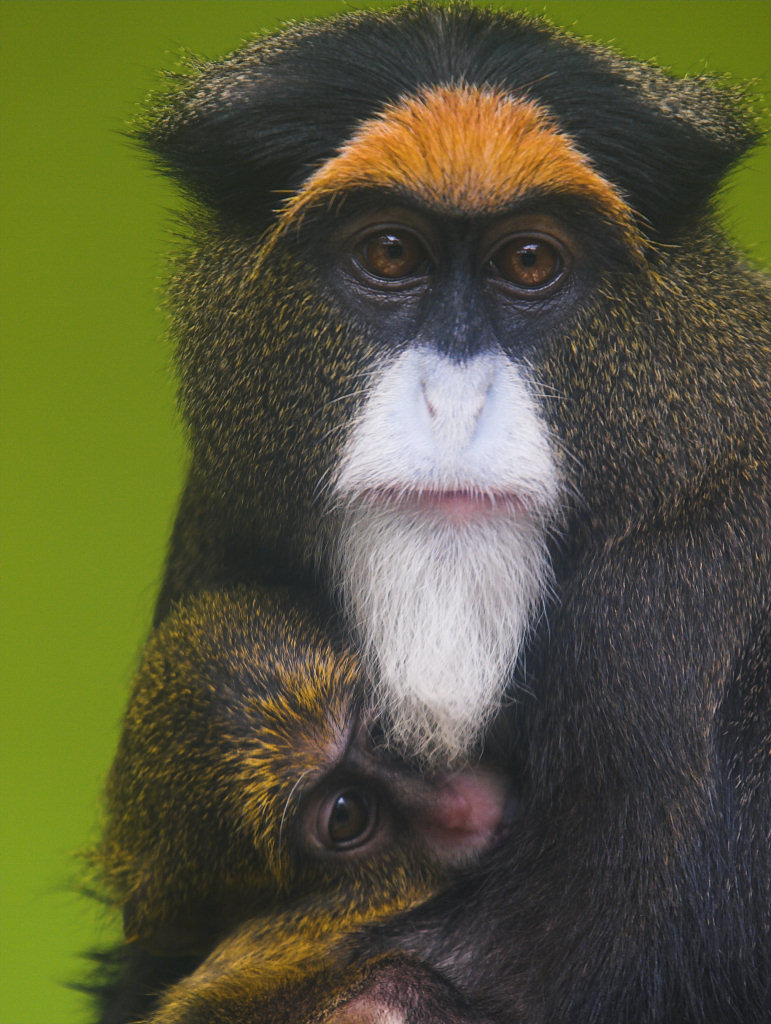
De Brazza's monkey
Cercopithecus neglectusRecognisable by its white beard and orange brow band, this shy monkey lives near rivers and flooded forests.

Crowned monkey
Cercopithecus pogoniasA colourful tree-dwelling monkey with a black crest and golden flanks, often in mixed groups with other guenons.

Moustached monkey
Cercopithecus cephusA small guenon with a white moustache and red tail, common in the south-eastern forests.

Putty-nosed monkey
Cercopithecus nictitansIts white nose stands out against dark fur. Its well-studied alarm calls are among the most elaborate of any primate.

Agile mangabey
Cercocebus agilisA ground-dwelling olive-grey monkey moving in noisy troops through swamp forests.
 VU
Black colobus
Colobus satanasEntirely black, this thumbless colobus spends its life in the canopy and is one of Central Africa's most threatened primates.
 LC
Mantled guereza
Colobus guerezaSpectacular with its mantle of long white hair and plumed tail, it almost glides from branch to branch.
 LC
Potto
Perodicticus pottoA big-eyed nocturnal primate that moves slowly through the branches and never loses its grip.
 LC
Demidoff's dwarf galago
Galagoides demidoviiOne of the world's smallest primates, under 100 grams, spotted at night by its eyeshine.
 NT
Bay duiker
Cephalophus dorsalisA small nocturnal antelope with a black dorsal stripe, hiding in thickets by day.
 LC
Blue duiker
Philantomba monticolaThe smallest forest antelope, barely 35 cm tall, usually seen in pairs.
 LC
Peters's duiker
Cephalophus callipygusAn orange-red antelope with a dark rump, active by day. Photo taken in Campo Ma'an National Park, Cameroon.
 NT
Yellow-backed duiker
Cephalophus silvicultorThe largest duiker, dark with a triangle of yellow hair on its back that bristles when alarmed.
 LC
Black-fronted duiker
Cephalophus nigrifronsA wetland duiker with elongated hooves suited to swampy ground.
 LC
Red river hog
Potamochoerus porcusThe most colourful wild pig: bright red coat, black-and-white mask and tufted ears.
 LC
Bushbuck
Tragelaphus scriptusA solitary antelope striped and spotted with white, typical of forest–savanna edges.
 LC
Roan antelope
Hippotragus equinusA large savanna antelope with curved horns and a black-and-white face, found in Mbam and Djerem.
 LC
Kob
Kobus kobAn antelope of plains near water, the male with lyre-shaped horns.
 LC
Hartebeest
Alcelaphus buselaphusA long-faced antelope with a sloping back, a fast runner of the northern savannas.
 VU
African golden cat
Caracal aurataAfrica's most elusive cat, twice the size of a house cat and very rarely seen.
 LC
African civet
Civettictis civettaA nocturnal carnivore with a black mask and spotted coat, known for its musk.
 LC
African palm civet
Nandinia binotataA small nocturnal tree-dwelling carnivore, one of the commonest mammals of African forests.
 LC
Servaline genet
Genetta servalinaA slender, serval-spotted carnivore hunting at night in the trees.
 LC
Marsh mongoose
Atilax paludinosusA brown, thick-coated mongoose always found near water.
 NT
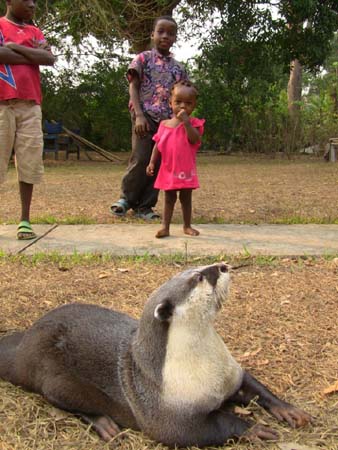
Congo clawless otter
Aonyx congicusA clawless otter with dexterous fingers, searching the mud of forest streams.
 NT
Spotted-necked otter
Hydrictis maculicollisA slender otter with a white-spotted throat, an excellent swimmer of clear waters.
 EN
White-bellied pangolin
Phataginus tricuspisThe commonest forest pangolin, yet one of the world's most trafficked mammals for its scales.
 VU
Black-bellied pangolin
Phataginus tetradactylaA tree-dwelling pangolin with a very long prehensile tail, active by day.
 LC
Aardvark
Orycteropus aferThe 'earth pig', a long-eared nocturnal digger, the only living member of its order.
 LC
African brush-tailed porcupine
Atherurus africanusA forest porcupine with a bristly tail tuft, common but nocturnal.
 LC
Hammer-headed bat
Hypsignathus monstrosusAfrica's largest bat; males gather at dusk along rivers to call for females.
 NT
Straw-coloured fruit bat
Eidolon helvumA large migratory bat forming colonies of thousands, including in towns.
 LC
Lord Derby's anomalure
Anomalurus derbianusA gliding rodent able to cover over 100 metres between trees with a skin membrane.
 LC
Giant otter shrew
Potamogale veloxA small nocturnal aquatic mammal like a miniature otter, a distant relative of Madagascar's tenrecs.
 LC
Western tree hyrax
Dendrohyrax dorsalisA small nocturnal herbivore whose piercing call rings through the forest at night. Its closest relative is the elephant.
 NT
Grey-necked rockfowl
Picathartes oreasAn iconic bird with a bare red-and-blue head that nests under rock overhangs. A trail leads to rockfowl caves near Somalomo.
 LC
Great blue turaco
Corythaeola cristataA large turquoise bird with a black crest whose rolling calls echo through the canopy.
 VU
Black-casqued hornbill
Ceratogymna atrataA large black hornbill with an imposing casque whose wingbeats can be heard from afar; a key seed disperser.
 LC
Piping hornbill
Bycanistes fistulatorA black-and-white hornbill with a plaintive call, often in noisy small groups.
 NT
Crowned eagle
Stephanoaetus coronatusAfrica's most powerful raptor, able to take monkeys and young antelopes.
 LC
Palm-nut vulture
Gypohierax angolensisA black-and-white raptor that is almost vegetarian, feeding mostly on oil-palm nuts.
 LC
African fish eagle
Haliaeetus vociferA white-headed fishing eagle whose call is one of Africa's most famous sounds.
 LC
Hartlaub's duck
Pteronetta hartlaubiiA shy chestnut duck with a black head, typical of shaded forest streams.
 LC
African pygmy kingfisher
Ispidina pictaA tiny orange-and-blue kingfisher that hunts insects away from water.
 LC
Black bee-eater
Merops gularisA black bee-eater with a bright red throat and blue sheen, hunting from exposed perches.
 LC
African green pigeon
Treron calvusA green pigeon perfectly camouflaged in foliage, very fond of figs.
 CR
Slender-snouted crocodile
Mecistops cataphractusA long, thin-snouted fish-eating crocodile, now among Africa's most threatened.
 VU
Dwarf crocodile
Osteolaemus tetraspisThe world's smallest crocodile, rarely over 1.5 m, heavily armoured and nocturnal.

Central African rock python
Python sebaeAfrica's largest snake, sometimes over 5 metres. Non-venomous, it constricts its prey.

Gaboon viper
Bitis gabonicaA snake with a spectacular geometric pattern, invisible in leaf litter, with the world's longest fangs.
 LC
Forest cobra
Naja melanoleucaA large glossy black cobra, agile on the ground, in water and in trees.
 LC
Nile monitor
Varanus niloticusAfrica's largest lizard, a strong swimmer often seen basking by rivers.

Home's hinge-back tortoise
Kinixys homeanaA forest tortoise whose rear shell can close like a hinged door for protection.

Goliath beetle
Goliathus goliatusOne of the world's heaviest insects, with larvae weighing up to 100 grams; a treasure of Cameroon's forests.

African giant swallowtail
Papilio antimachusAfrica's largest butterfly, up to 23 cm across, and one of the most toxic.
Freely licensed photos (Wikimedia Commons). Unless stated, they were not taken in the East Region.
Which animal would you like to see?
Pick an animal to discover the sites where it can be seen, possible visits and immersive experiences.
Wildlife quiz
10 photos, 4 answers: test yourself and challenge your friends.